Panel presenter · Conference on Policy Process Research
Navigating Central and Grassroots Actors in Chinese Poverty Alleviation
Abstract and contribution
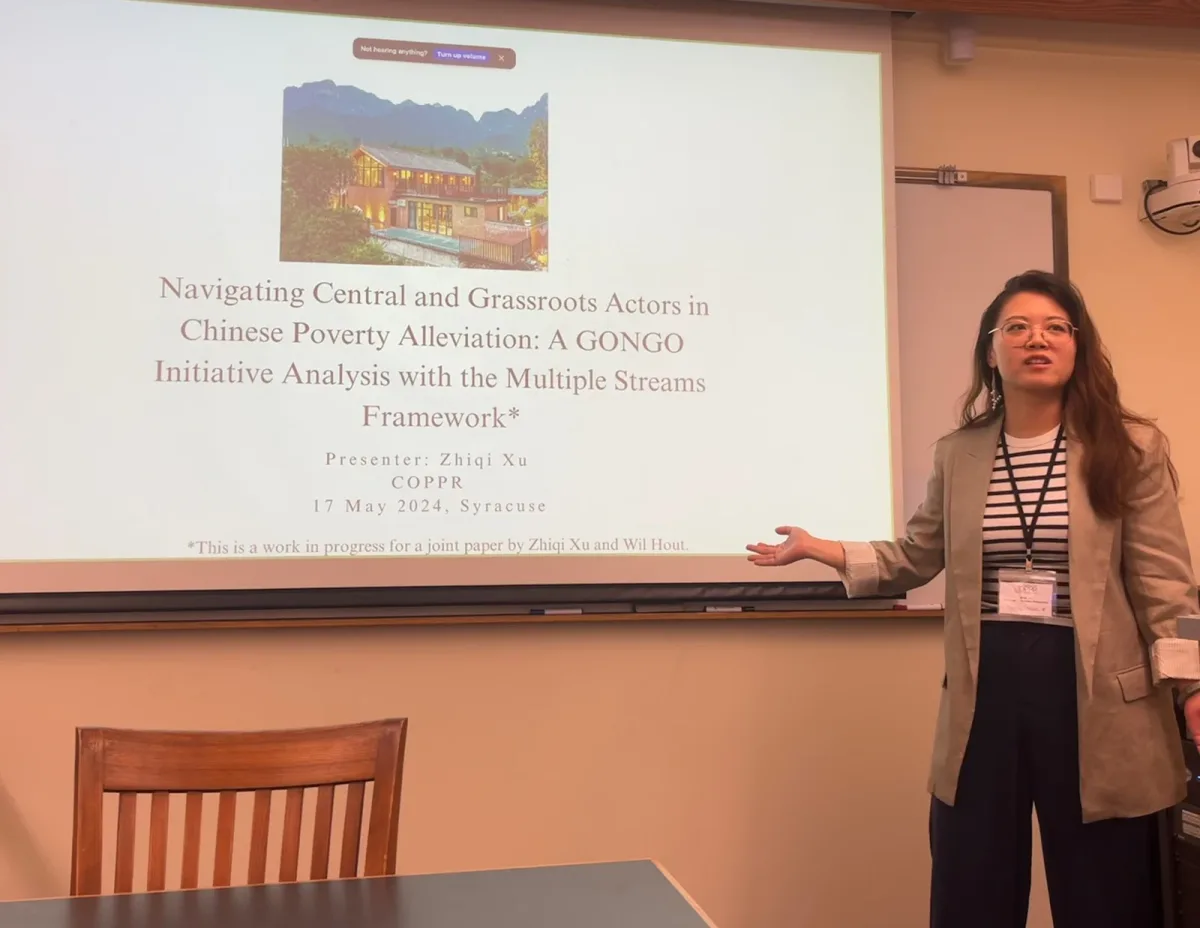
Panel at Conference on Policy Process Research 2024 | Navigating Central and Grassroots Actors in Chinese Poverty Alleviation: A GONGO Initiative Analysis with the Multiple Streams Framework
In China’s four-decade journey of poverty alleviation (PA) practices, PA policies are featured by a campaign-style approach initiated by the central government. Existing studies on PA policies often focus on national and provincial authorities, overlooking local governments (Liu, 2022), as well as other actors that could function as policy entrepreneurs. This paper examines the case of the China Foundation for Poverty Alleviation (CFPA), a government-organized non-governmental organization (GONGO) that has experimented with distinctive approaches to poverty alleviation involving various local actors, particularly through the Bonavilla (BV) project. BV is a community-based rural tourism development project which ran from 2000 to 2022, across two significant phases: policy formation (2000-2012) and policy adoption and implementation (2013-2022). BV represents a paradigm shift towards community-driven development and grassroots participation, serving as a model for participatory and community-based programs in rural areas (Liu, 2021).
We employ the Multiple Streams Framework (MSF, Kingdon, 2014) to analyze policy-making in authoritarian China. While the MSF was developed to study policy making in democratic countries, recent studies have shown its applicability in authoritarian states under certain conditions (van den Dool, 2023). The framework has hardly been used to analyze poverty alleviation policies in China. Our analysis draws from diverse data sources such as interviews, site visits, and public documents, allowing a deep exploration of BV and policy processes.
The paper aims to address three key questions: 1) How does a GONGO act as a policy entrepreneur in China? 2) How do grassroots and central agencies influence policy innovation within BV? 3) What lessons can be extracted from BV’s processes for understanding and adjusting MSF in autocracies?
This examination of the BV project sheds light on policy entrepreneurs and grassroots participation in shaping policy outcomes in authoritarian contexts, enriching the discourse on poverty alleviation strategies.
(Based on collaborative research with Prof. Wil Hout at International Institute of Social Studies, Erasmus University.)